
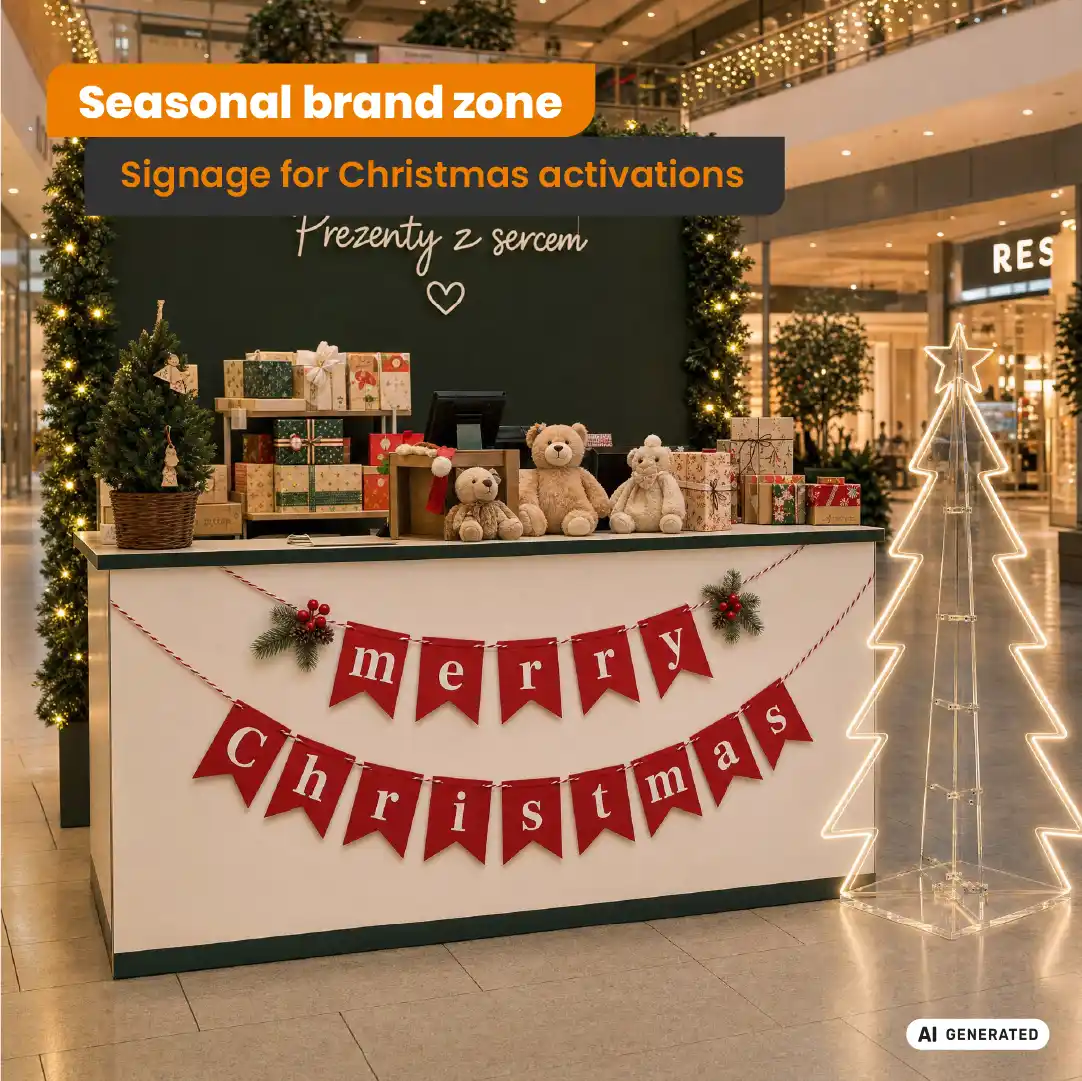
A Christmas activation rarely comes down to a single display. There is the entrance to the zone, signage, the place where customers interact with the brand, sometimes a sales or photo area, and elements that need to remain visible after dark. Add several locations, different file formats and a launch date that cannot simply move with the production schedule.
For an agency, this is where the most difficult part of the project often begins. It is no longer about ordering a banner or an exhibition wall. It is about combining different elements into one project and making sure the materials that are needed are ready when installation starts.
Start with the role of each part of the zone
Instead of starting with a product list, map out what the space needs to do. The entrance should be easy to notice and find. This may call for feather flags, banners or directional signage.
If the zone needs to be visually separated from its surroundings, you may need event barrier covers and fence graphics, printed carpets or floor coverings or other elements that define its boundaries.
At the point where people interact directly with the brand, function matters more. Should visitors take a photo? Talk to staff? See a product? Pick up a sample? Depending on the answer, the right solution may be an advertising wall or display, a counter, a POS element or textiles.
If the space also operates after dark, visibility becomes a separate part of the project. This is where you can consider illuminated advertising: a lightbox, 3D letters, Neon Flex or an illuminated display structure.
Not every Christmas brand zone needs all of these elements. A well-designed project starts with function and only then moves on to the choice of media.
One zone may require several production technologies
A banner, fabric, cardboard, carpet and backlit graphic do not behave in the same way. They are made from different materials and may be produced using different technologies.
This matters especially when brand colours are important.
You should not assume that the same colour will look exactly the same on every substrate. In a project that combines several media, it is worth agreeing an approved colour reference in advance and deciding which elements require closer visual control.
Placing a larger part of the project with one producer does not create one colour profile for everything. It does, however, make it easier to agree production parameters, reduce the number of places where they have to be monitored and identify differences caused by materials or technologies earlier.
Several locations are not always the same project multiplied by the number of sites
For an activation running in several shopping centres, stores or public locations, check from the start whether every site really uses the same set of materials.
Entrance widths, available signage areas, fixing methods, language versions, the number of barriers or space for a freestanding structure may all differ.
That is why one file labelled “location 1, 2, 3” with a single set of dimensions is often not enough.
A safer approach is to prepare a production list: location → element → dimensions → quantity → artwork version → installation date.
With a dozen elements, this may look like extra work. With a dozen locations, it starts saving work.
What most often complicates a project like this?
In agency projects, production itself is not always the biggest problem. Complications often start earlier: the client approves some materials while still changing others; files arrive in batches; the list of locations changes; or an extra format appears that was not included in the original brief.
The later these changes appear, the less time there is to react.
For a Christmas brand zone, it is therefore worth separating three dates: client approval, delivery of complete production files and installation.
They are not three names for the same deadline.
When a broader scope with one producer really helps
For a simple project, one producer may only be needed for one category.
With a zone made up of banners, display systems, POS materials, textiles and illuminated advertising, the situation changes. Every additional supplier means a separate quotation, technical arrangements, lead time and transport.
Labo Print covers several production categories that can appear within one activation. This does not mean that one person manages every part of the project or that every technology goes through the same team. In practice, specialists from the relevant areas are involved.
The benefit for the agency lies elsewhere: instead of finding a separate producer for each category, a larger part of the scope can be handled in one place.
For a complex activation, having fewer suppliers to coordinate is a value in itself.
What changes when the days get shorter?
In November and December, some Christmas zones operate for many hours after dark. This is particularly relevant for outdoor activations, Christmas markets, ice rinks, city zones and building entrances.
That does not mean every project needs a neon sign or lightbox.
At the design stage, however, it is worth answering a few simple questions: from what distance should the signage be readable, what lighting is already available on site, and which element should be the main brand identifier after dark?
Only then can you decide whether the existing lighting is enough or whether the zone needs its own illuminated element.
Neon Flex, a lightbox or 3D letters can mark the entrance, present the logo or become the main visual element of the setting. Illuminated advertising is useful here when it solves a specific visibility problem, not as a compulsory Christmas decoration.
When the deadline starts getting tight
In seasonal projects, some decisions really do come late. An agency may receive final client approval several days later than planned, or a change to one element may appear at the very end.
In that situation, first check which parts of the project are already ready for production and which are still blocked.
For selected Labo Print products, Express production in 24/48 hours may be available. It does not apply automatically to every product or every order. Accelerated production must be confirmed for the specific scope and date.
That matters more than the word “Express” itself.
If a client asks on Wednesday whether a material can be ready by Friday, the answer should depend on actual production availability, not simply on the existence of an urgent-production option.
What should be ready before you send the brief to the producer?
For a more complex Christmas brand zone, it is worth collecting the following in one place:
- a list of all locations and their installation dates,
- the elements needed at each location,
- dimensions and information about where each item will be installed,
- quantities and artwork versions,
- which elements will be used indoors and which outdoors,
- approved colour references if brand colour is critical,
- file status: ready / in progress / awaiting approval,
- which elements need to be delivered together.
If some information is not yet known, it is worth saying so. The producer then knows what can already be checked and what still has to wait.
A Christmas brand zone starts with a good production plan
With one wall or banner, the route is straightforward.
With a dozen elements, several technologies and several locations, the way the whole project is prepared becomes much more important.
The point is not to order everything as early as possible or to produce everything with one company at any cost. It is more important to establish which elements need to work together, which are dependent on one another and which dates genuinely cannot move.
Only then can you choose materials, technologies and a realistic schedule.
Planning a Christmas activation or seasonal brand zone?
Send us the list of elements, locations and installation dates. We will check which parts of the project can be combined within our production scope, what we need for the quotation and which lead times are realistic.