
Cast foil
Cast foil is a printable adhesive film designed for wrapping vehicles and other surfaces with embossing, recesses and curves. It is chosen when standard vinyl may not conform well to complex shapes. Thanks to excellent tensile properties and solvent HR printing, it supports precise, durable advertising graphics that can be finished cut to size or cut to shape.
| Printing technology | Solvent HR |
|---|---|
| Thickness | 50/70 μ |
| Print resolution | 1440 dpi |
| Maximum material width | 1,52 m |
| Finish of material | cut to shape, cut to size |
| Properties | excellent tensile properties |
| Intended use | surfaces with large embossing |

Price from: €18,50 /m2



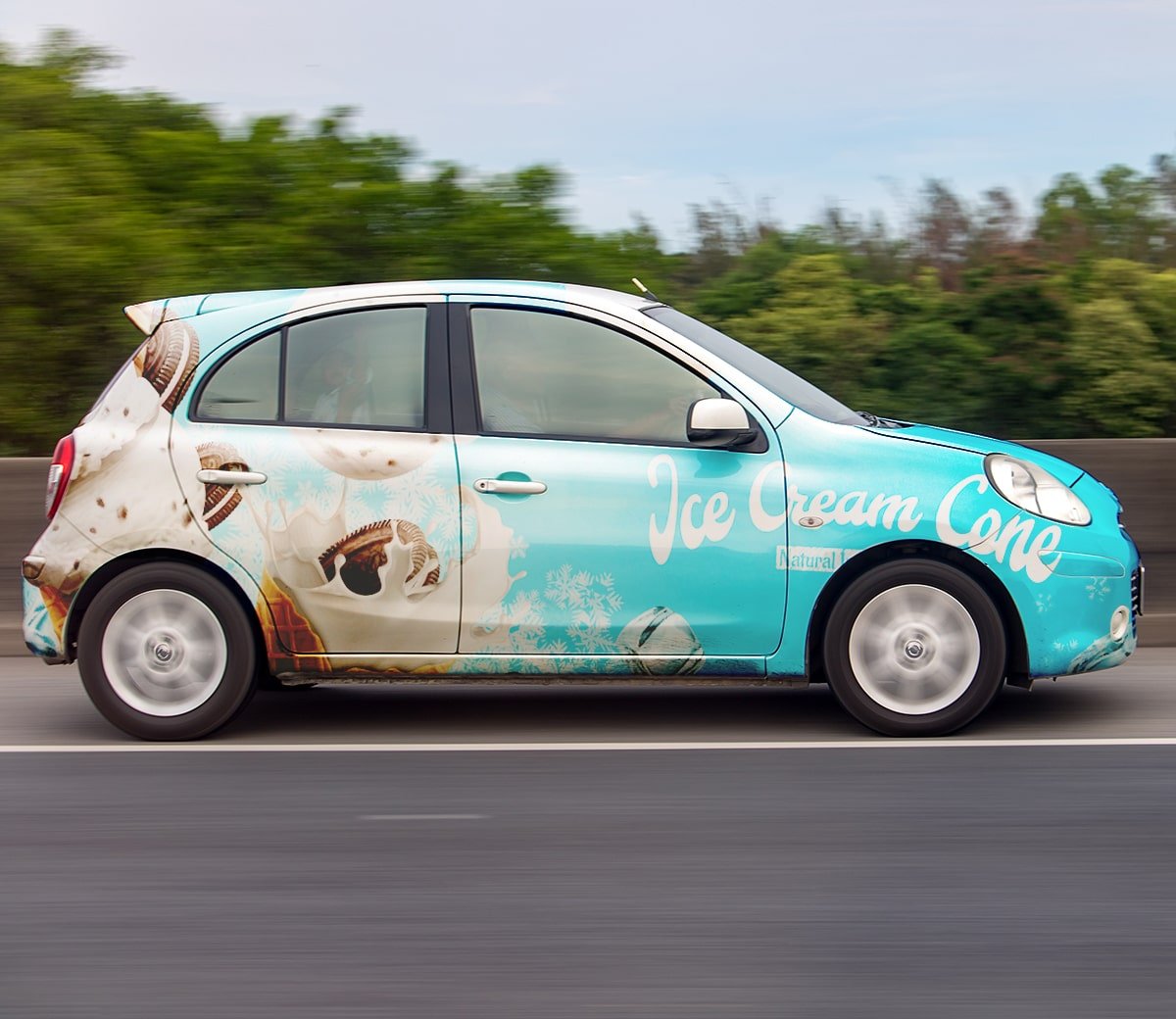
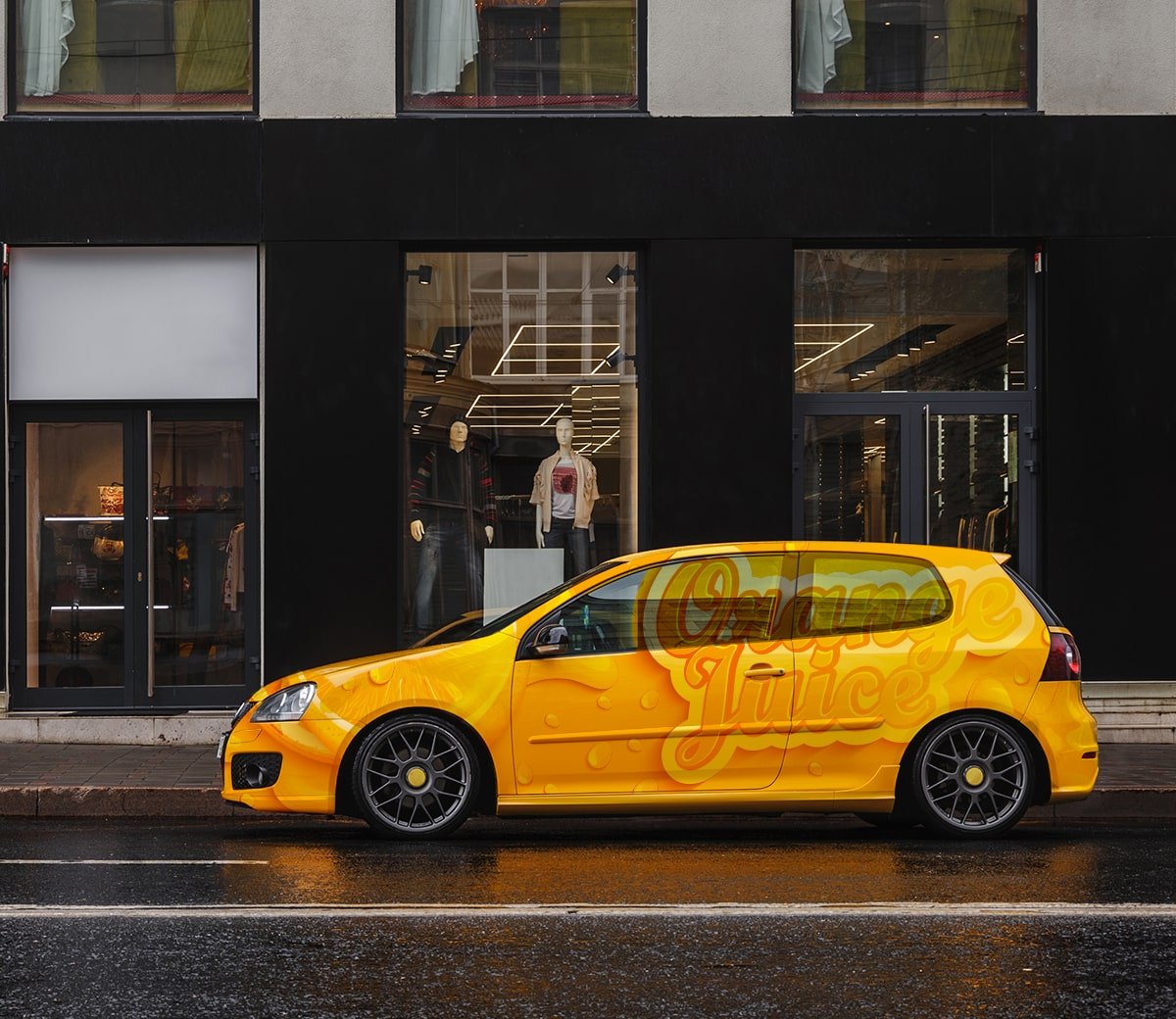
Cast foil is a specialist adhesive material for demanding applications on curved, embossed and irregular surfaces. It is particularly useful for vehicle wrapping, full-surface advertising and branded elements where the film must follow the shape of the substrate without losing the readability of the print.
What makes cast foil different?
Unlike standard self-adhesive films, cast foil is designed for surfaces with large embossing, indentations and curves. During application, it can be shaped using temperature, which helps the installer adapt the material to complex areas. The film memory can be reset during application, so the material may be repositioned when working on difficult details and deep recesses.
The material has excellent tensile properties, which makes it suitable for projects where flexibility and controlled forming are important. This is why it is often selected for car wrapping, advertising on vehicles and other irregular advertising surfaces.
Print quality and finishing
Cast foil is printed using Solvent HR technology with a print resolution of 1440 dpi. This supports sharp, readable graphics for commercial branding, fleet markings and promotional applications. The available material width is up to 1.52 m, which is practical for larger vehicle panels and wide-format elements.
The material can be finished as cut to size or cut to shape, depending on the design, installation method and required visual effect. For long-term vehicle graphics, the printed cast foil should be protected with an additional car laminate. Lamination helps protect the print against sunlight, wind, moisture and everyday outdoor exposure.
When is cast foil the right choice?
- for wrapping vehicles with many curves, recesses and irregular details,
- for full-surface advertising on cars and commercial fleets,
- for colour change or large branded vehicle areas,
- for advertising applications where the substrate is not flat.
Installation requires experience, suitable tools and a correctly prepared design. A well-fitted project should account for the shape of the vehicle or surface before production begins.
How to prepare a cast foil project
Cast foil works best when the design is prepared for the exact shape and size of the wrapped surface. For vehicle projects, the artwork should take into account doors, handles, recesses, curves, panel gaps and areas where the film will be heated and formed. This is especially important for full wraps and large advertising layouts, where even small misalignments can affect the final visual result.
Before production, it is worth deciding whether the foil should be cut to size or cut to shape. Cut-to-size finishing is practical for rectangular or panel-based applications. Cut-to-shape finishing is useful when the design includes logos, irregular outlines or elements that need to follow a specific contour.
Printing and lamination recommendations
The print is produced in Solvent HR technology at 1440 dpi, which supports detailed advertising graphics and clear branding. For vehicle applications, the printed surface should always be protected with a suitable car laminate. The laminate improves resistance to external conditions and helps maintain the appearance of the print during long-term use. According to the product specification, the average durability after lamination is estimated at 10 years.
Cast foil can be supplied with different adhesive types depending on the project requirements. Common options include permanent adhesive and channelled adhesive, which can support installation on larger or more demanding surfaces. The final adhesive choice should be matched to the substrate, expected use and installation conditions.
Where cast foil is commonly used
- commercial vehicle wraps and fleet branding,
- advertising graphics on cars with deep recesses or embossing,
- large promotional surfaces exposed to outdoor conditions,
- decorative and branding applications on non-flat substrates.
What to check before ordering
For best production results, provide artwork at the correct scale, with adequate bleed and clear cutting instructions if contour cutting is required. Important elements such as text, logos and contact details should not be placed too close to panel edges, recesses or areas that will be strongly stretched during installation.
On the market, cast foil is also commonly referred to as cast vinyl, car wrap film or car film. These terms usually describe the same type of high-performance material used for wrapping complex shapes. In this product, the key selection criteria are the surface shape, expected exposure, finishing method and whether lamination is required for long-term outdoor use.
Application should be carried out by experienced installers using appropriate equipment. Correct heating, forming and post-heating help the material adapt to curves and recesses, while careful surface preparation supports adhesion and the final appearance of the wrap.