
Mid-September. You walk past a competitor’s shop window and notice it’s already fully dressed. Pumpkins, spiders, orange banners above the confectionery aisle. Your brand hasn’t sent a brief yet, because Halloween is still six weeks away. The problem: that competitor sent their brief two weeks ago.
Halloween is no longer a niche event — it’s a full retail season across Europe. The battle for customer attention doesn’t begin on 31 October. It begins much earlier — and it’s won or lost in production planning.
Halloween in the UK and across Europe — a full retail season, not an optional extra
In the UK, Germany and the Netherlands, Halloween is a mainstream retail season with budgets comparable to Christmas in some product categories. Retailers like Tesco, Asda, Boots, Sainsbury’s and Primark dedicate entire seasonal zones to Halloween — with bespoke window graphics, POS campaigns and in-store trail materials launched weeks in advance. Halloween is a fixed line item in retail marketing budgets, not an optional add-on.
The question is not whether your brand runs a Halloween campaign, but when the brief goes out — and whether there’s still a comfortable production window left before the competitor’s window display goes up first.
What a Halloween campaign in-store involves
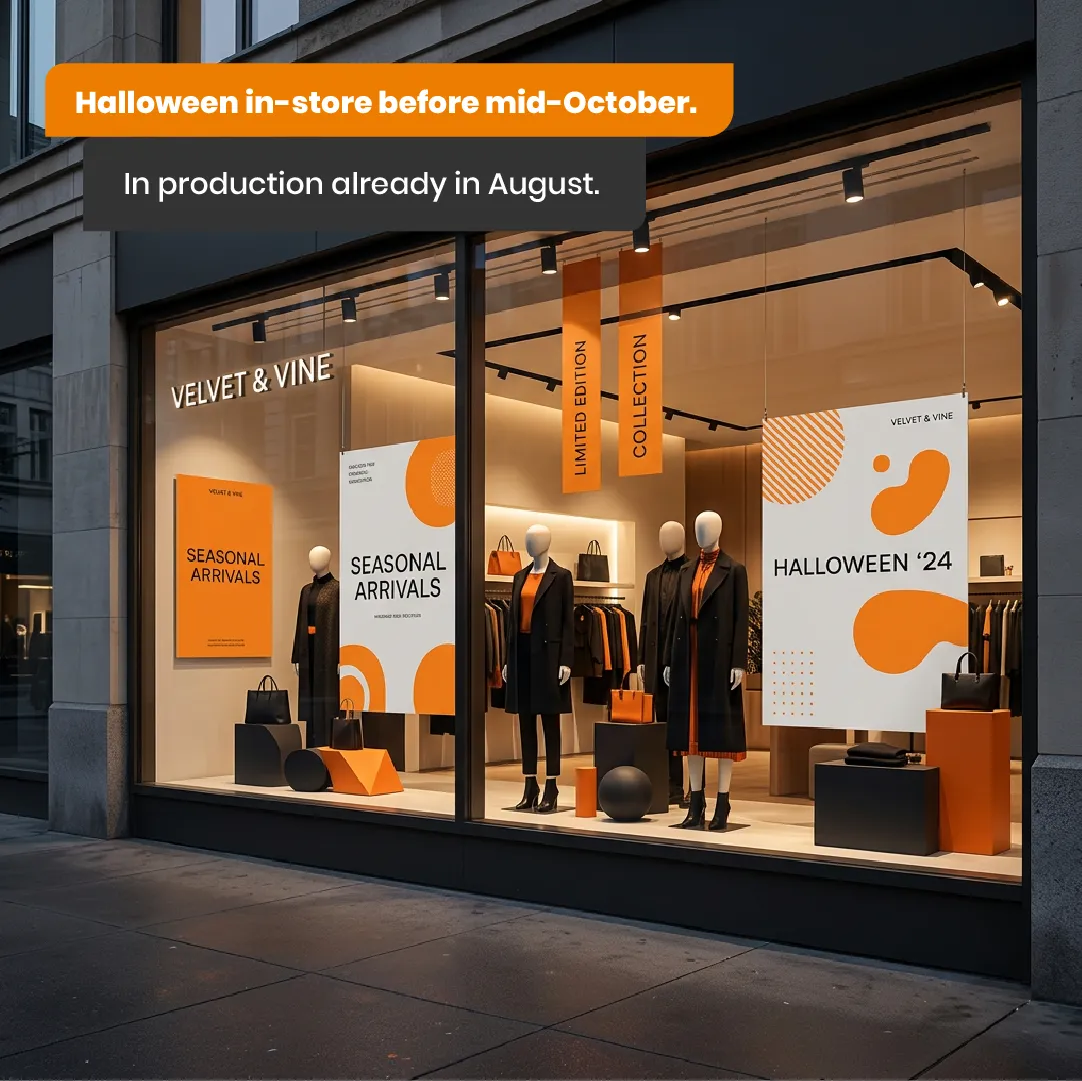
Halloween demands visual consistency — the same graphic motif must hit window, interior banner, floor and checkout zone simultaneously. Splitting formats across different suppliers risks the pumpkin orange coming out in three different shades.
– Window graphics and vinyl decals. First line of communication — they decide whether the shop is playing Halloween or just enduring October.
– Interior banners and aisle communication. Drive footfall into the seasonal zone, communicate promotions and build the buying atmosphere.
– Floor graphics. Trail to the Halloween zone, thematic zone marking — an underrated format with a strong cost-to-impact ratio.
– POS displays and stands with seasonal artwork. Showcase for seasonal products — confectionery, decorations, costumes. Seasonal artwork on a display sells better than standard artwork.
– Checkout zone materials. Impulse purchase at the till closes the campaign at the final step of the shopping journey.
Why August — not September
Work backwards from the end date. Materials should be in-store before 15 October — that’s when the real competition for the customer begins. Add delivery time, production (5–10 working days for standard formats, longer for network campaigns and non-standard sizes), artwork approvals and time for any file corrections.
- 15–31 October campaign live in stores
- 1–14 October installation, final deliveries
- 20–30 September production and dispatch
- 10–20 September artwork approval, final print file
- August–September brief, quote, artwork development
- August → NOW — brief to the producer
A brief sent in August provides a comfortable buffer. A brief sent mid-September eliminates that buffer and turns every day into an express order.
One motive — multiple formats. And one supplier
A Halloween campaign typically has one core visual — a graphic motif that appears across all materials simultaneously. Window graphics with one printer, checkout banners with a second, floor stickers with a third — that’s a direct route to inconsistency visible to the customer at a glance.
A producer delivering the whole campaign in one place guarantees colour calibration across formats, a single delivery schedule and one contact for all potential changes. For a campaign covering 20 or 30 locations, that’s the difference between a manageable project and a chaotic one.
Planning a Halloween campaign for your stores?
Send us a preliminary specification now — materials list, formats, number of locations and target installation date. We’ll prepare a quote and propose a schedule for the whole campaign: from window graphics to floor stickers.
Placing the production order requires finished files — so it’s best to prepare them and place the order already in August, before the first-week-of-September pressure returns.