
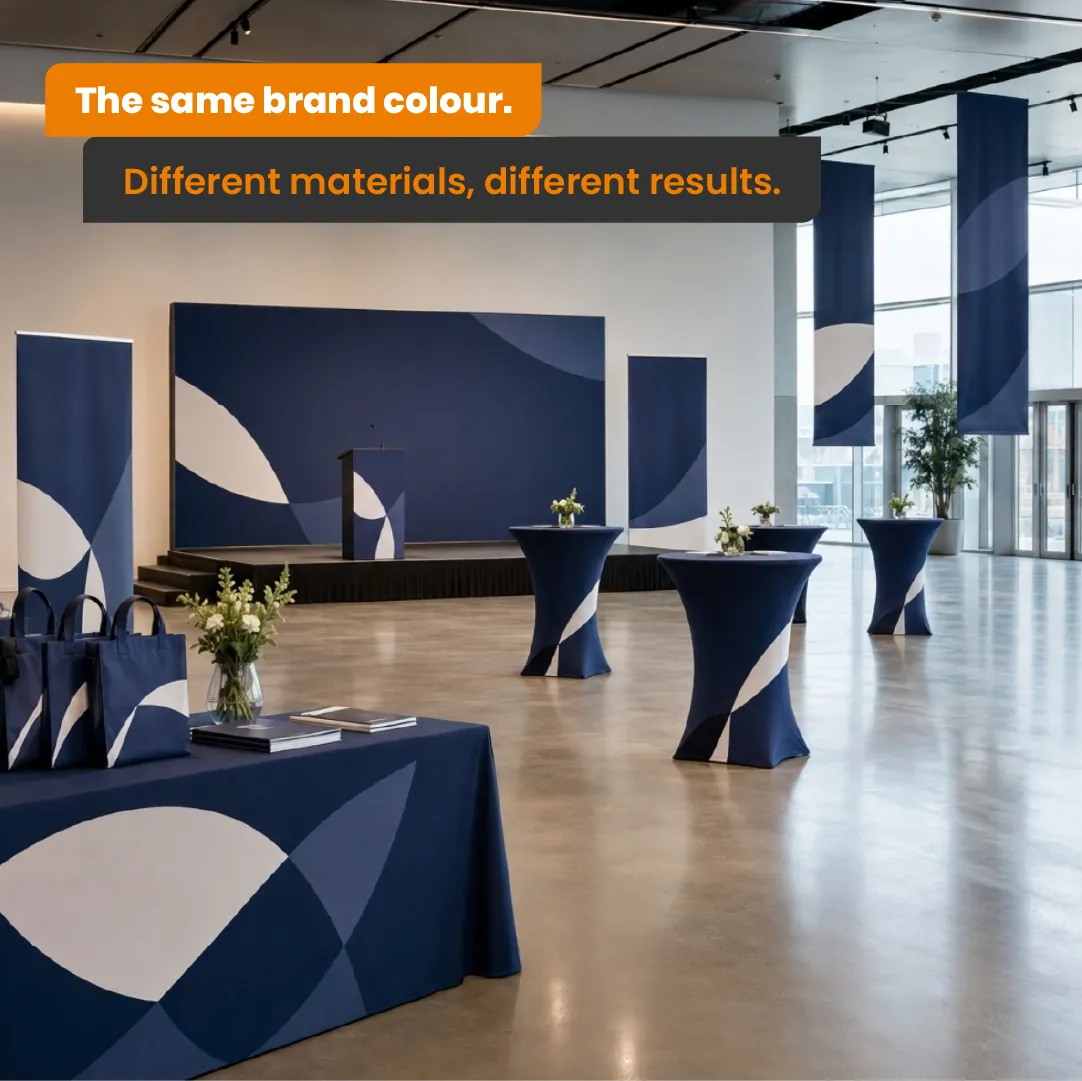
The photo gallery from last year’s company gala. The event backdrop behind the podium: brand colour, navy, everything matches. The roll-up at the entrance: almost navy — slightly warmer, slightly more purple. The branded tablecloths: a completely different shade, clearly too light. In the room it may not have been noticeable. In the photographs — it is perfectly visible. And those photographs will stay in the company gallery for the next three years.
This is not the fault of a bad printer. None of those materials were defective. Each one came out exactly as it should from that particular substrate. The problem lay elsewhere — and it could have been eliminated before anyone placed the first order.
Brand colour is an illusion of consistency — until it stands side by side on six different substrates
Pantone 281 C is a reference standard. But a reference standard for offset printing on coated paper under standardised lighting. The same colour on sublimation polyester fabric, Frontlight material, self-adhesive vinyl or mesh will not look identical. These are different substrates, different print technologies, different surface structures and different ways of interacting with light. Each can produce a different colour effect.
This is neither a designer’s error nor a producer’s weakness. It is the physical property of materials. Sublimation fabric renders colour differently from Frontlight material printed using UV or solvent HR. Roll-up graphics, self-adhesive vinyl, backlit displays and display fabrics will also behave differently. Substrate, print technology, surface structure and the way light is reflected or transmitted all vary. Each of these effects shifts the perceived colour — and that effect is independent of how good the producer is.
Corporate events are the most demanding colour test of the year
In an outdoor campaign, materials are spread across a city — the difference in shade between a banner in one location and a roll-up in another is practically impossible to detect. At a corporate event, all formats stand in the same room, under the same spotlights, for several hours — and every photograph documents them simultaneously.
A typical Q4 corporate event brings together at least several different print formats at once:
– Event backdrop / press wall. Can be made from sublimation fabric, a textile material such as Blackback, mesh or another substrate matched to the structure and venue.
– Roll-ups, banners and entrance signage. These can be different substrates: roll-up graphics, Frontlight material, vinyl or rigid board. Each can produce a different colour effect.
– Directional signage and room identification. Self-adhesive vinyl or rigid materials — another category altogether.
– Decorative and textile elements. Fabrics, tablecloths, styling elements and branded add-ons — material, technology and venue lighting all matter here too.
– Stage and space graphics. Stretch fabric, event carpet, spatial graphics — often a mix of technologies in one location.
The more formats from different technologies stand side by side, the more visible the difference in brand colour becomes — especially under cool hall lighting or a photographer’s flash.
Touch the material before deciding what to order for the event
You are ordering a 3×2 m backdrop for a company gala worth several thousand pounds. You have a dozen materials to choose from — sublimation fabric, frontlit, polyester of various weights, stretch, vinyl mounted on a rigid board. Each absorbs colour differently, behaves differently under the halogen lighting of a banqueting hall and looks different in photographs.
Labo Print has a banner and textile materials sample book — a physical set of prints on different substrates and in different print technologies. The sample book lets you compare how the same reference graphic looks on materials such as Frontlight, polyester, Mesh flag, Stretch PRO, Blackback, Carpet, vinyl or selected rigid materials.
With the sample book in hand, you can see and feel the difference between individual materials and print technologies on the same colour, across a dozen materials simultaneously — and decide which substrate will work best for your specific event. Before placing an order. Before anything goes into production.
Why a screen render is not enough
A monitor displays colours in RGB mode with its own calibration profile. Print works in CMYK on a physical substrate that absorbs dye. A render is a simulation — and a good one — but it cannot replace a sample book held in your hands under the actual lighting of the event venue.
Particularly sensitive to the difference between screen and print: cool colours (navies, cobalts, purples) and dark saturated reds — exactly the colours that appear most often in corporate brand guidelines. Ask your account manager about the Labo Print materials sample book before placing an order for event materials.
One producer for event formats — greater control over colour
Colour calibration is not a “once and for all” service. With every new production run, colour is matched from scratch — order history does not replace current machine calibration. Colour consistency across formats is easier to maintain when materials are planned together, with one colour reference and one coordination process. This does not mean every substrate will reproduce colour identically, but it lets you spot differences in advance and choose materials so the overall effect is as consistent as possible.
A producer delivering the backdrop, roll-ups and directional signage simultaneously calibrates all formats to the same result. A producer who only makes the backdrop has no idea how the roll-up ordered earlier from another supplier was calibrated — and has no tool to check.
For a corporate gala whose photographs will appear in annual reports and board presentations — this is not a minor detail.
Planning print materials for a Q4 corporate event?
Ask about the Labo Print materials sample book before placing your order. You will see how the same colour reference graphic looks on sublimation fabric, Frontlight, mesh and vinyl — and decide what will work best for your event, before anything goes into production.
Write to us with your list of formats and event date — we will recommend materials and discuss the details of your order.