

The client approves the brief on Tuesday at 4pm and asks whether materials will be ready by Friday morning. That question comes up regularly in every agency. The answer is almost never straightforward and rarely sounds like “yes, definitely”.
Express printing is not just time at the machine. Before the artwork reaches the banner, it goes through file verification, the production queue, finishing and logistics. Each of those stages takes time, and any one of them can block the entire schedule if something goes wrong.
What goes into production time
When you say “express print”, you think of the machine. The print shop thinks of the entire chain that starts before the machine and ends after it.
1. File verification
The file goes to technical verification. We check bleeds, resolution, colour profiles and embedded fonts. That is not a two-minute review, and for complex jobs it can take several hours. If the file needs corrections, the express clock starts running from the moment we receive the corrected version, not from the moment the first file arrived.
2. Production queue and slot availability
An express deadline is not an automatic guarantee. At certain points in the season, production capacity for a given day is already taken. It is worth confirming slot availability before placing an order, especially if the client has already promised a specific delivery date.
3. Production and finishing
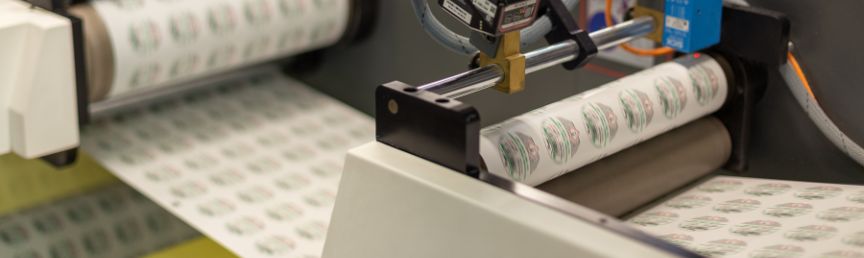
The print itself is one stage. Then there is cutting, eyelets, lamination, tunnel, velcro or whatever finishing you ordered. Standard production time is usually 1–2 business days. In express mode, for selected products, that drops to 24 or 48 hours. For larger jobs or non-standard formats it may differ.
4. Delivery
The courier usually picks up twice a day. Delivery time to the client depends heavily on the destination market — Labo Print fulfils orders across Europe, and “express” to a client in one country means something different than to Scandinavia, Southern Europe or more distant markets. So with a tight deadline it is worth confirming the real delivery time for the specific country. This is the stage agencies most often leave out of their calculations. Express printing does nothing if the parcel arrives a day late anyway.
A realistic express schedule
Example for a market with a short delivery time: file ready and correct by Monday noon, slot availability confirmed, 24h production, delivery → materials with the client mid-week. On more distant markets the delivery itself extends this schedule, so it is worth confirming the delivery time for the specific country when ordering.
That schedule works if all four stages run without problems. One file error or a delivery issue pushes everything back.
Why the file decides the entire schedule
In agencies that order print regularly, the most common reason for missing a deadline is not the production queue or a courier delay. It is the file.
Wrong bleeds, fonts not converted to outlines, too low a resolution, a colour profile in RGB instead of CMYK — these are errors that require corrections from the client or the design studio. Every round of corrections is time taken out of the schedule. In express mode there is no room for two or three rounds.
A correctly prepared file is a condition, not an option. If an agency sends a project to print without a prior technical check, the risk of delay is high regardless of whether the order is standard or express.
What to do when you have little time
A few things that reduce risk when the deadline is tight.
- Check the file before sending. A technical checklist before ordering takes a few minutes and can save several hours of corrections. Bleeds, embedded fonts, resolution, colour profile. If you are unsure about a specific parameter, it is better to ask the print shop before sending than after. See also: how to prepare a file for large-format printing.
- Confirm express slot availability. Before you tell the client “yes, we will make it”, check with the print shop whether the chosen slot is free. That question comes to us, not to the calendar.
- Split the order if you can. Not every element of a campaign needs to go express. A roll-up the client picks up a day earlier can be done in standard and save the surcharge. Express makes sense for the products that are on the critical path of a specific event.
- Have a plan B. If one supplier has no free slot, it is worth having a contact at a second one. In agencies that order print often, a trusted second supplier is part of risk management, not a sign of failure.
How much more express costs and when it makes sense
Our express surcharge is +20% on the standard price. Not +50% or +100%, as it sometimes is on other platforms. That is a concrete figure you can give the client when negotiating the cost of urgent production.
Express makes sense when three conditions are met at the same time: the client genuinely needs the materials in a short timeframe, the file is ready and correct, and you have confirmed slot availability with the print shop. If any of those conditions is not met, the express surcharge will not speed up delivery.
Sometimes it is faster and cheaper to speed up the file preparation stage than to order express on a file that still needs corrections.
How to avoid working in express mode every day
Agencies that regularly order express print often do so not because the projects are genuinely urgent, but because the order passed through too many hands or the client approved the brief too late.
A few things help: technical checklists before sending files, an internal time buffer in project planning, and placing the production order as soon as the client signs off rather than after the artwork is finally locked.
July is quieter than September. Mid-week is quieter than Friday. Materials ordered with a few days to spare cost less and arrive without stress.
Have an urgent job or questions about a deadline?
Write or call. We will check slot availability, tell you which products qualify for express production and confirm the schedule before the order is placed.
For agencies working with many clients we can also discuss terms for ongoing collaboration.