When shorter days work in your brand’s favour
An October evening, 5:30 p.m. A shopping street at dusk. The unit across the road glows with an illuminated light box bearing its logo, visible from a hundred metres away. And your sign? Printed film on the façade that, at this hour, is already almost invisible.
It is not a matter of poor design. That is simply how non-illuminated advertising works: visible by day, it loses its power after dark. From October to March the day lasts seven to nine hours at our latitude. Illuminated signage can keep working even when there is no natural light left.
Autumn and winter mean extra hours of exposure
Autumn and winter are often associated with the season when outdoor advertising loses visibility. With illuminated signage, the opposite can be true.
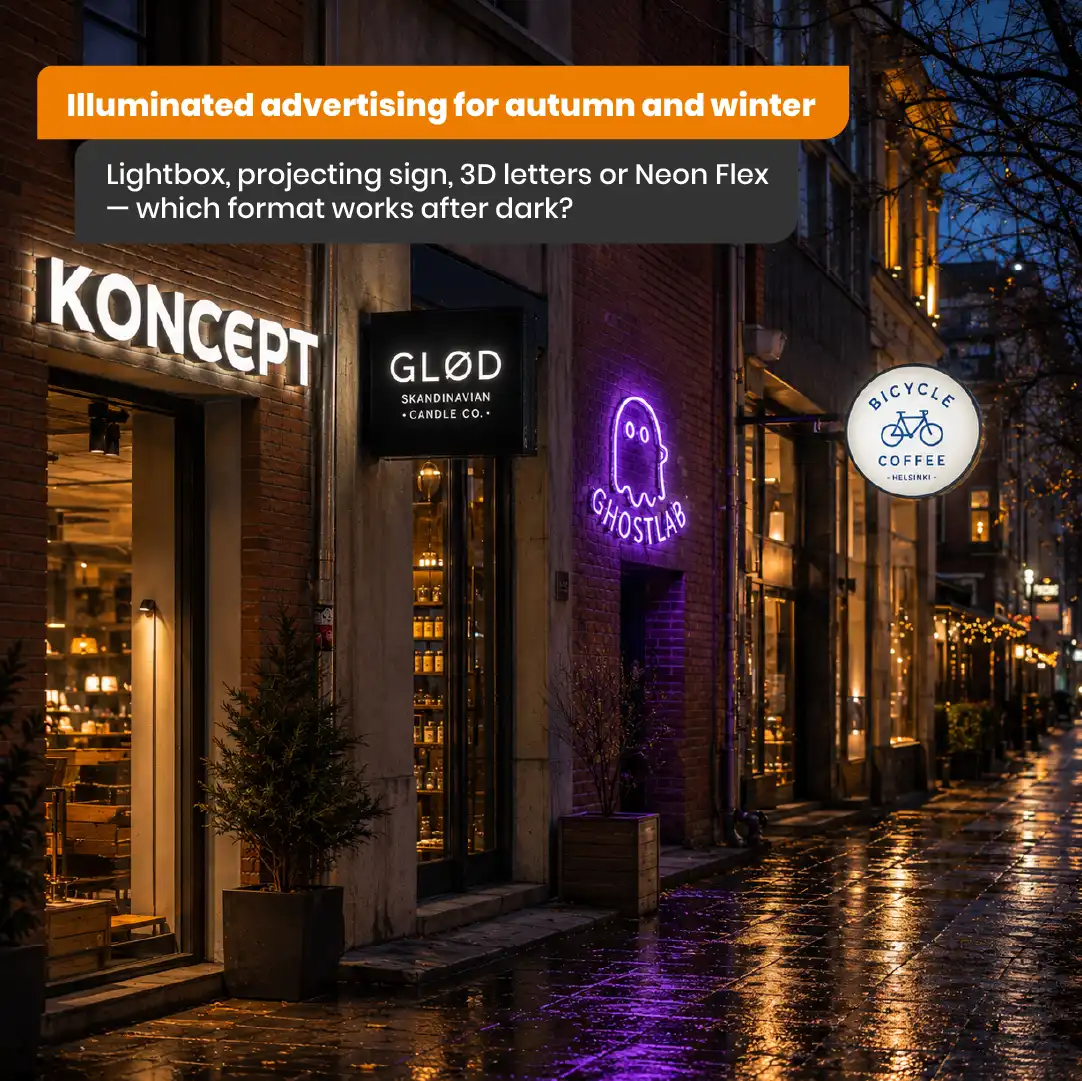
In June the sun sets after 9 p.m., so a sign benefits from daylight for most of the day. In December the sun sets before 4 p.m. A customer leaving work is already out after dark and notices what is lit far more easily. An illuminated light box, a projecting sign by the entrance or three-dimensional LED letters become especially visible then, while non-illuminated signage elements lose legibility.
Which format of illuminated signage to choose — and when
Illuminated signage covers several different solutions, each answering a different signage need. What matters is the mounting location, the direction the viewer looks from, and the effect the brand wants to achieve. Below are four formats and a hint on when to reach for each.
Light box sign
Choose it when you need a company sign on a building façade — above the entrance to a shop, showroom, service point or office. A light box works both by day, as clear signage, and after dark, as an illuminated identity element. It also works well indoors — wherever a large, legible surface for graphics matters.
If the unit needs to be clearly visible from the side of the street or from a greater distance, a projecting sign will be the better choice.
Projecting sign
Choose it when the unit sits on a busy street and the signage should be visible to people walking along the pavement or driving past. A projecting sign is mounted perpendicular to the façade, so it is clearly visible from both directions. IP67 — full resistance to weather conditions.
If the viewer looks mainly straight on at the unit, a light box will be the more legible solution.
3D letters
Choose them when the brand should be visible and legible from various directions and the signage should also build image. 3D letters give a different effect from a flat sign: they have depth, cast a shadow and can be visible after dark. Illumination can be done in several ways: from the back (HALO effect — a soft glow on the façade or wall), from the front (strong, clear letter contrast), simultaneously front and back (maximum visibility) or front and side, through a perforated tape (extra glow at the letter edge). Non-illuminated letters are also possible, as well as — as a special solution — letters filled with LED neon.
They require a design consultation before ordering — the choice of material, depth and mounting depends on the display location.
Neon Flex
Choose it when you need an illuminated element inside the premises — as decoration, a message or an element of brand identity. Neon LED Flex works well in interior signage, commercial spaces, offices, showrooms, hospitality and catering, and in event and trade-fair projects. The shape can be fully customised. Neon is available in 11 colours and can be mounted directly to the wall, on a backing and spacers, suspended, or as part of a larger spatial structure (box-to-box).
This is an interior-only solution — Neon Flex is not intended for outdoor display.
Three questions that narrow the choice
1. Outdoors or indoors? — Neon Flex indoors only. The other three solutions can be used both outdoors and indoors.
2. Straight on or from the side? — A light box works best when the viewer looks at the façade straight on; a projecting sign works when the unit also needs to be visible from the side.
3. Just the name/logo or a larger surface for a message? — 3D letters showcase a name or logo well, while a light box gives more room for graphics, background and additional information.
Design before quote — why it is worth starting with a conversation
Illuminated signage is always made to individual order. The quote depends on the mounting location, dimensions, material and lighting method, so it cannot be prepared reliably without a preliminary description of the location and expectations. Every project therefore starts with a conversation, not a price list.
For autumn and winter projects — so the sign is ready before the day shortens below eight hours — it is worth starting that conversation in October.
ExpoLab by Labo Print
Illuminated signage is part of the signage and display offer delivered by Labo Print under the ExpoLab by Labo Print brand. All formats — light boxes, projecting signs, 3D letters and LED Neon Flex — are designed and quoted individually.
Planning illuminated signage?
Describe your location, the type of place and the way the signage should be visible. We will advise on the format, select the material and prepare an individual quote.
Full illuminated signage offer: https://laboprint.eu/en/category/illuminated-ad/
Contact: [email protected]