
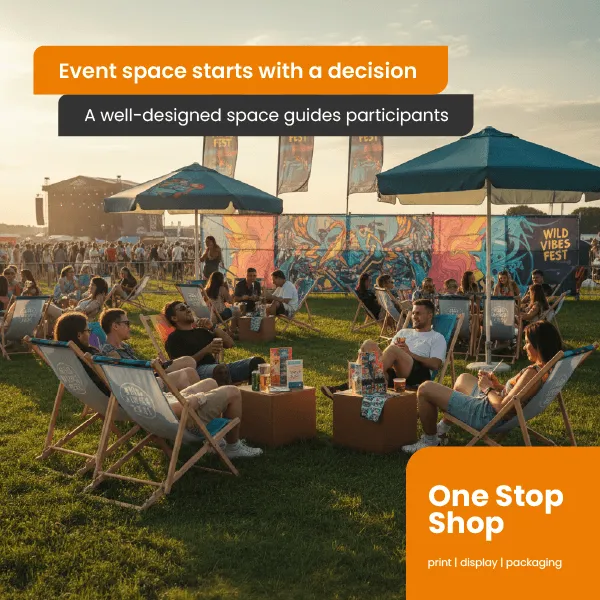
A well-designed event space doesn’t draw attention to itself.
It simply works.
Participants go where they need to go, see what they should see, and don’t have to think about what’s next.
And that’s the hardest part — designing a space that guides instead of needing explanation.
From our perspective, most issues don’t come from a lack of budget or ideas.
They come from decisions made too late — or without considering production and installation realities.
Entrance – the first filter
The entrance is where participants decide whether to engage with the event space at all.
It doesn’t have to be spectacular.
It has to be clear and visible from a distance.
In practice, that means:
- whether the element is visible from tens of meters away,
- whether the structure can withstand a full day (or several days) in changing conditions,
- whether installation won’t take half a day before the event starts.
These are the things you rarely see in visualisations — but they quickly show up in real-life execution.
Navigation – does the participant have to think?
If participants have to stop and ask “where next?”, something isn’t working.
The most common mistake is treating signage as an add-on.
In reality, it’s one of the key elements of the space.
A well-designed navigation system:
- is consistent,
- works from different distances,
- doesn’t get lost among other messages.
And importantly — it has to match the environment.
What works indoors often fails outdoors.
Zones – where people actually stay
On the plan, everything looks right.
In reality, participants choose their own spots.
That’s why it’s worth thinking not only about where things “should be”, but:
- where people will want to sit,
- where they will stay longer,
- where they will actually engage with the brand.
This is where the quality of solutions becomes visible —
whether something is comfortable, stable, and durable under heavy use.
Sponsors – visibility is not enough
A logo on a backdrop is no longer enough.
If a partner is present only visually, their presence quickly fades into the background.
The most effective elements are those that are actually used:
- photo spots,
- spaces where people spend time,
- elements that appear in event coverage and content.
It’s not about more formats — it’s about using them better.
Conditions – often overlooked
Outdoor, indoor, one-day event, multi-day festival — each requires different solutions.
Yet many decisions are still made “by eye”, without considering:
- weather,
- installation method,
- transport,
- production timelines.
The result?
Elements that looked great in the design phase become a problem during execution.
That’s why planning an event space is not just about layout —
it’s also about material and technical decisions.
One partner or many?
Production can be split between multiple suppliers.
And often it is.
But that comes with:
- differences in quality,
- lack of consistency,
- more coordination under time pressure.
That’s why more and more projects are handled in a one-stop-shop model —
not for convenience, but for control over the entire process.
What remains after the event?
A lot of potential is often lost once the event ends.
Elements created for the event can:
- be reused in retail,
- work in showrooms,
- return in future projects.
But only if that’s considered from the beginning.
Final thought
A good event space doesn’t have to be complex.
But it has to be thought through.
For participants, everything should feel obvious.
For organisers — that’s where the real work shows.